45 Deg. Assembly Cutter 2174
No Reviews Yet |
Write a Review

$84.99 ea.
How Do You Want It?
Pickup In-Store
Click to choose a location
Ship to My Door
Arrives Sun, Oct 11 - Thu, Oct 15
Product Description


Materials: Natural woods, composite woods, hard plastics
Recommended RPM: 12,000-15,000 (max 18,000)
Chamfer bits provide that elegant angle to the side of your workpiece and are one of the most popular edge forming bits. A Double Chamfer is capable of cutting two chamfer designs with one bit. They also feature an adjustable cutting length (maximum cut length of 1-5/8"). For replacement cutter heads, order 2174RH for the shank cutter or 2174LH for the top cutter.
- TOOL SPECS: Carbide-tipped double chamfer bit with 45° angle, 1-3/8" large diameter, 1/2" shank, and 3-3/4" overall length for use with 1/2" collets.
- DOUBLE CHAMFER: Create two 45-degree designs with a single bit assembly, offering a maximum 1-5/8" cut length for clean, precise edges on various materials. Ideal for efficient, detailed work.
- ADJUSTABLE LENGTH: Quickly adjust the cut length to match the stock thickness by adding or removing shims. 1-5/8" maximum cut length.
- REPLACEMENT CUTTERHEADS: Both cutters can be replaced for extended tool life. Add RH to part number for shank cutter, and LH for end cutter (e.g., 2174LH).
- MATERIALS: Perfect for use on natural woods, composite woods, and hard plastics, providing clean and precise cuts across a variety of surfaces.
- CARBIDE TIPPED: Offers an excellent balance of quality and cost, making it ideal for a wide range of applications.
No Reviews Yet! Write a Review
The Joys of Building with Great Woods
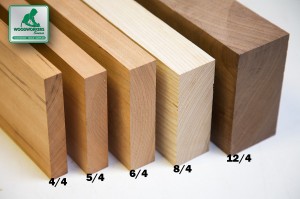
What's 4/4, 8/4, 12/4, etc.?
Understanding hardwood lumber starts right here with these wacky fractions.
Understanding hardwood lumber starts right here with these wacky fractions.

Lumber Grades Explained
If you're expecting perfect clear lumber 100% of the time, you're in for a surprise. Here's a summary of the hardwood lumber grades and what to expect from them.
If you're expecting perfect clear lumber 100% of the time, you're in for a surprise. Here's a summary of the hardwood lumber grades and what to expect from them.
3 Steps To Figure Out How Much Lumber You Need
Board feet isn't your everyday kind of math, but these three simple steps make it easy to figure out your project.
Board feet isn't your everyday kind of math, but these three simple steps make it easy to figure out your project.

Project Planner Worksheet
Here's a handy (and free) Excel worksheet that helps you estimate the lumber needs for your project.
Here's a handy (and free) Excel worksheet that helps you estimate the lumber needs for your project.

Understand Wood Toxicity & What You Should Do About It
Are woods poisonous? Hazardous to use in cutting boards or baby cribs? Find out here.
Are woods poisonous? Hazardous to use in cutting boards or baby cribs? Find out here.

Wood Moves - Here's What You Need to Know
Wood is like a sponge, and it's always in a state of absorbing or releasing moisture to stay equalized with its environment. The problem with that is it also swells and shrinks. Here's what you need to know to protect your project.
Wood is like a sponge, and it's always in a state of absorbing or releasing moisture to stay equalized with its environment. The problem with that is it also swells and shrinks. Here's what you need to know to protect your project.