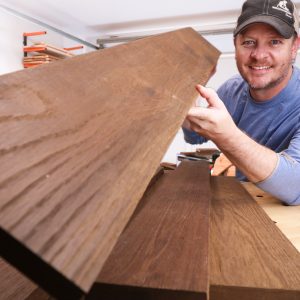
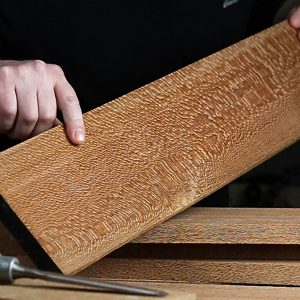
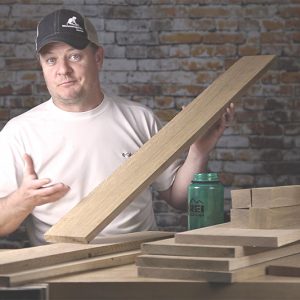

Here’s yet another helpful video by George Vondriska from Woodworkers Guild of America, and in this one he explains how logs are sawn and how different parts of the tree produce different grain patterns. Flat sawn lumber is the most economical way to saw a log and the process produces grain patterns that are wide and cathedral like. Quarter sawn, on the other hand, is more labor intensive and therefore more expensive to buy. Quarter sawn boards have a straight grain pattern, and the lumber is generally more stable than flat sawn. In this video, Vondriska illustrates how this is done by using a slice of a log to show us what’s going on. Enjoy.
Archive for the ‘Wood Conversations’ Category
What Does Quarter Sawn and Flat Sawn Mean? What’s the Difference and Why Do I Care?
Friday, April 12th, 2013How to Make Walnut Woodworking Projects Look Great with Dye & Stain
Wednesday, February 6th, 2013It’s a simple reality that walnut used in woodworking projects has two troublesome traits. First, the natural dark color of walnut will fade over time due to UV light exposure. The process is slow, but it happens. Second, walnut lumber contains some pale sapwood, depending on your tastes, you either like it or not. However, there is a very easy way to make the color last a long time, make the heartwood and sapwood blend, and still maintain a nice, dark, chocolatey walnut color that’ll make your projects look beautiful.
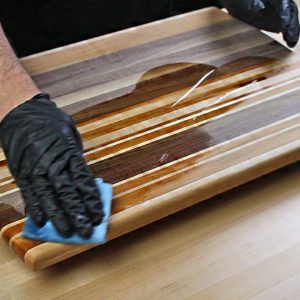
We’ve written up the process on how to do this in 3 Great Ways to Hide Sapwood, but we decided it was time to show how it’s done with a video. The video just shows the process, and that’s where the magic is. It’s not really in the specific brands or products I’ve used here. You can use different colors of dye and stain to come up with a final appearance that suits your taste.
Post your questions at the bottom.

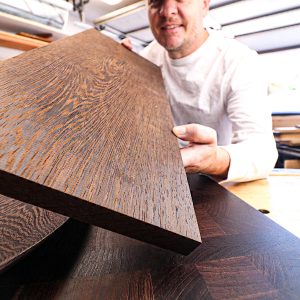
Two walnut boards compared. Bottom is raw, top is dyed, stained, and finished to hide the sapwood. Can you tell where the sapwood and heartwood meet? Look closely, scroll down.
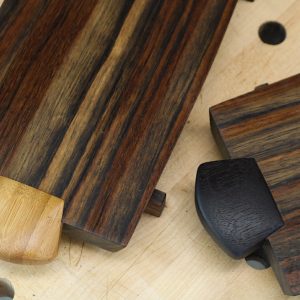
Get a little closer to that finished piece, and you’ll see how well that the sapwood blends right into the dark heartwood while keeping a beautiful dark walnut color:
3 Great Ways to Hide Sapwood in Walnut
Thursday, March 29th, 2012
Look close. This piece of walnut is not only finished with a clear lacquer but the light colored sapwood has been evened out to nearly match the heartwood. Woodworking with walnut today means dealing with the sapwood. Here are 3 ways.
Few people approve of pale sapwood in their walnut lumber, but in the words of Jim, a salesman at one of our faithful walnut suppliers back east, “When people ask me for a 100% heartwood face in walnut, I just tell them they’re dreaming.” You may be tired of hearing that sapwood isn’t considered a defect when it comes to grading lumber, however it is an industry fact. Lumber grade is a mathematical computation of the amount of clear wood in a board – so says the National Hardwood Lumber Association, the organization responsible for defining the rules of the lumber trade.
“But it’s a defect to me,” says the woodworker.
So what’s a woodworker to do? Fortunately, lumber producers separate their walnut inventory not just by grade but also by color. The good news is 100% heartwood walnut can be had; the bad news is few can afford it. For the most part, about the best balance between color, cost, availability is called 90/70 heart: that means 90% heartwood on the face, 70% heartwood on the back. Remember, lumber has two broad sides, a face and a back, and when building furniture and cabinetry, only one side is displayed in the final product.
Sure, it’s possible to find some 100% heartwood boards from time to time, but on a consistent basis and in large quantities? Not really. And therefore, when you visit your nearest lumber supplier, you’ll never have a perfect pile of full brown walnut to select from. Full heartwood boards are the exception to the rule, so it’s time to look at how woodworkers are using walnut in today’s woodworking.
You’ll find a number of discussions and blogs about this topic, and a good one in particular is this found at Lumber Jocks, www.lumberjocks.com/topics/10565, which discusses three ways woodworkers overcome sapwood.
3 Ways to Deal with Sapwood in Walnut:
- Cut sapwood off, and/or hide the sapwood on parts that will not be seen frequently
- Live with sapwood in your finished project
- Use a dyeing and staining process to make the color even
Those first two are straightforward.
Dyeing and staining needs some explanation, though. Since you’re not going to be able to go the woodworking store and buy a bottle of Sapwood Hider right off the shelf – alas, no such miracle exists – there are a couple of steps involved, but they’re easy.

Walnut board clearly shows a sapwood edge until the piece is dyed, sealed, stained, and finished. A saw kerf line separates the two sections.
For this method, we’re specifically talking about dye and there are a number of dyes on the market, usually mixed with water or denatured alcohol. Dye is different from stain, as dye doesn’t obscure the grain, which is pretty important when using walnut.
The basics:
1. Apply a very diluted dye in a color of your choice to the entire piece, heartwood and sapwood. The dye used in the pictures here is Behlen Solar-Lux™ medium brown walnut color. Solar-Lux™ is UV resistant and fade resistant, which is great because when walnut is left natural, it eventually turns very tan. Walnut ought to be dyed or stained anyway to retain a pleasing color. Note: Medium brown walnut Solar-Lux™ dye will appear orange when you apply it, but that’s okay. The next steps will bring the color back to dark brown.
2. Seal the wood with a light coat of sanding sealer or shellac. This needs to be thin to allow for the next step to have some effect.
3. Apply an oil-based stain on top of the sealer. Wipe it on, wipe it off. This adds a touch of pigment to the pores equally to you get a consistent color across the board.
4. Apply your clear finish of choice. Varnish, lacquer, etc.
It should go without saying that you should always test your dye process on a few test pieces before committing the dye to your final product. You’ll need to test different dilution ratios of your dye before you get the color you want.
Dyeing walnut is not very difficult, but it will take some time. However, you’ll greatly increase your yield of wood and you’ll make the beautiful walnut color last much, much longer than you would if if were to leave the wood natural.

This part of the board is finished with just a clear coat of Zinsser Sealcoat and lacquer. The sapwood strip stands out. Eventually the color of this board will lighten.
Build Furniture You Can Be Proud Of: Try Sapele
Sunday, November 14th, 2010Here’s a hardwood you really don’t want to miss: Sapele
Take a look:
That’s the real stuff. You can see that it shares a likeness with mahogany, but still has a personality all of its own. Sapele comes from massive trees of 150 feet tall, and over 4 feet in diameter. To make it better, the trunks reach about 80 before branching off so boards are clear and perfect.
And are you wondering, “Yeah, but does it make good furniture?” Take a look at this one, found on lumberjocks.com. Click it to see the close up photos.
It’s a stunning example of design and execution, don’t you think?
And yes, the sapele in the cabinet looks very purplish – the creator mentions that he used tung oil as his finish; whereas in the comparison pictures above, I used just a swipe of mineral spirits to show how a finish brings out the ribbon stripes.
When you’re done drooling over that fine project, take a look at our supply of Sapele right here.
Mahogany: Which one is the real thing?
Sunday, September 12th, 2010Any discussion of Mahogany may be complex and confusing because there has been a lot of change in the past few years and the term “mahogany” has been applied to several woods for marketing purposes. There is no botanical connection among these different woods. I will try to keep this short and to the point but there is a lot of information available. Click the heading name for detailed information in the Wood Library.
Today the most widely distributed and used “mahogany” in the marketplace is African mahogany. 


